
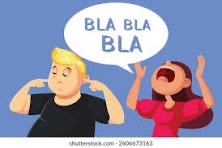
“You are an excellent conversationalist,” I remarked to a friend-as a compliment first- and then, second, to assure her that my next assessment had nothing to do with her.
“But it’s really disappointing to say that I only know a rare number of good ones, like you”
To which she spat out,
“I can’t stand self absorbed motor mouths!”
One of whom is a lovely friend of mine who called to chat. Or, really to have me listen to what he wanted to chat about. He’s Ivy educated, multilingual and quite successful. He called to tell me about a recent success. A brilliant project he was heading up. Very interesting story. Although after 45 minutes of direct stream of consciousness dialogue my ears started to hurt.
“Wonderful chatting,” I abruptly announced.
“But I have to go now.”
Given the decisive nature of my interruption you might have suspected my friend would have “heard” me and responded like this.
“Off you go, then.”
Instead, and in light of what I have shared so far, it might not surprise you that it seemed my desire to exit this alleged conversation did not supersede his wish to continue it. Albeit, again, on his terms.
“You are such a good listener,” he exclaimed enthusiastically. “That’s a sign of high intelligence,” he added.
Nice tactic. But this use of flattery to sway me off course might have been effective if it had led to some meaningful exchange about this titillating characterisation he had of me. But, alas, I felt confident its purpose was simply to allow him more space in which to explore-single handedly- his musings about good listeners.
Something CNBC psychotherapist and career coach Jenny Maenpaa actually does here.
”Some people are “naturally gifted with [active listening skills] from an early age, and often receive feedback like, ‘You’re so easy to talk to!’ or ‘I feel like I’m the only person in the room when we talk,’” says Maenpaa.
“Yes, active listening is a significant indicator of high intelligence, particularly emotional and cognitive intelligence,” adds AI.
Quite. But “listening” non stop makes for a dull afternoon unless you are a psychiatrist and are being paid handsomely to do it. Furthermore, if listening is the hallmark of high intelligence then my friend should qualify as an Olympic champion himself as he is far brighter and better educated than I.
Which then begs this unsettling question:
Is he just not that interested in what I have to say, save my attentive responses to whatever he is talking about?
So it would seem. Or perhaps he just doesn’t know better. Either way, only
“Active listeners respond with questions because they are genuinely curious about what you’re saying,” says Maenpaa.
Which must then mean that the opposite is also true. That to never ask a question is the epitome of disinterest.
So, in such instances one can avoid this verbal narcissist or take action.
“You have to stick up for yourself,” says Psychology Today contributor, Gregg Levoy, “as uncomfortable as that may be.” Levoy goes on to describe one such a sticky case where courage instead of avoidance prevailed.
“Recently, my partner and I met a couple who spent the first 20 minutes of our acquaintance monopolizing the conversation. Suddenly, my partner gently and amiably blurted out,
“I’m wondering if you’d like to hear something about ourlives.”
Lavoy then writes about what followed.
“Inside me bombs burst in air and men dove for cover.”
Levoy – an avowed people pleaser- adds he would never have confronted the pair like this, but inside he was applauding his partner’s nerve.
It’s all about self care, he reminds and recognizing what Truman Capote once said.
“A conversation is a dialogue, not a monologue. That’s why there are so few good conversations, due to scarcity; two intelligent talkers seldom meet.
And as far as conversation starters go, phrases such as, “What’s Up?” are weak instigators of valuable exchanges.
“A friend of mine told me that she feels a bit anxious when someone greets her with the phrase, “What’s up?” writes Well newsletter publisher, Jancee Dunn, “Because oftentimes nothing is up.
“It makes me a little embarrassed,” she said. “Shouldn’t I have some things that are up?”
Indeed. However, just adding one word to your inquiry can suggest real interest on the part of the inquisitor.
“If you know someone fairly well,” says Dr. Leslie John of The Harvard Business School, “poor communicators should swap
‘How are you?’ for
‘How are you feeling?’
Including that one word can make the conversation richer, Dr. John said.
“That gives the person an opportunity to say something a little less rote, and they’re going to pause and consider their answer,” she said.”
Then there’s the person who, after commandeering the proverbial stage for far too long suddenly gasps and boldly announces,
“Oh, I have been going on forever about myself. Tell me what’s happening with you?”
“Ah, the classic “reverse uno” card! “ says AI. “When someone drops that line, it usually means the conversation has been heavily one-sided, and they are awkwardly trying to hand the microphone over to you.”
But the suggestion to relinquish control by the conversational narcissist feels disingenuous and fails to ignite a robust response. Why did it not occur to you to ask me a question earlier, you might think? Or, on what planet would anyone be interested in an hour long dissertation about the state of your sock drawer or workout regime?
Despite epic boredom at times, Levoy suggests one should always persevere in the name of improvement and the pursuit of happiness.
“Refusing to speak up for yourself in conversation is not only a microcosm of other arenas of your life, but it’s an obstacle to the essential work of being seen and heard and known, and the very human hunger to truly connect with one another.”
Human beings are indeed the most interesting things on the planet and can provide a never ending source of joy, fun, learning and support. And conversation is the vehicle to intimacy with them. There is nothing better than sitting down with someone you like and solving all the problems of the world over a good glass of wine and dinner. It’s nourishment in itself and should be one of our favorite, entertaining pastimes.
 Burning Daylight
Bravo! Canât wait to solve world problems with you and wine. Cathie Barner415 652-8154
LikeLike