
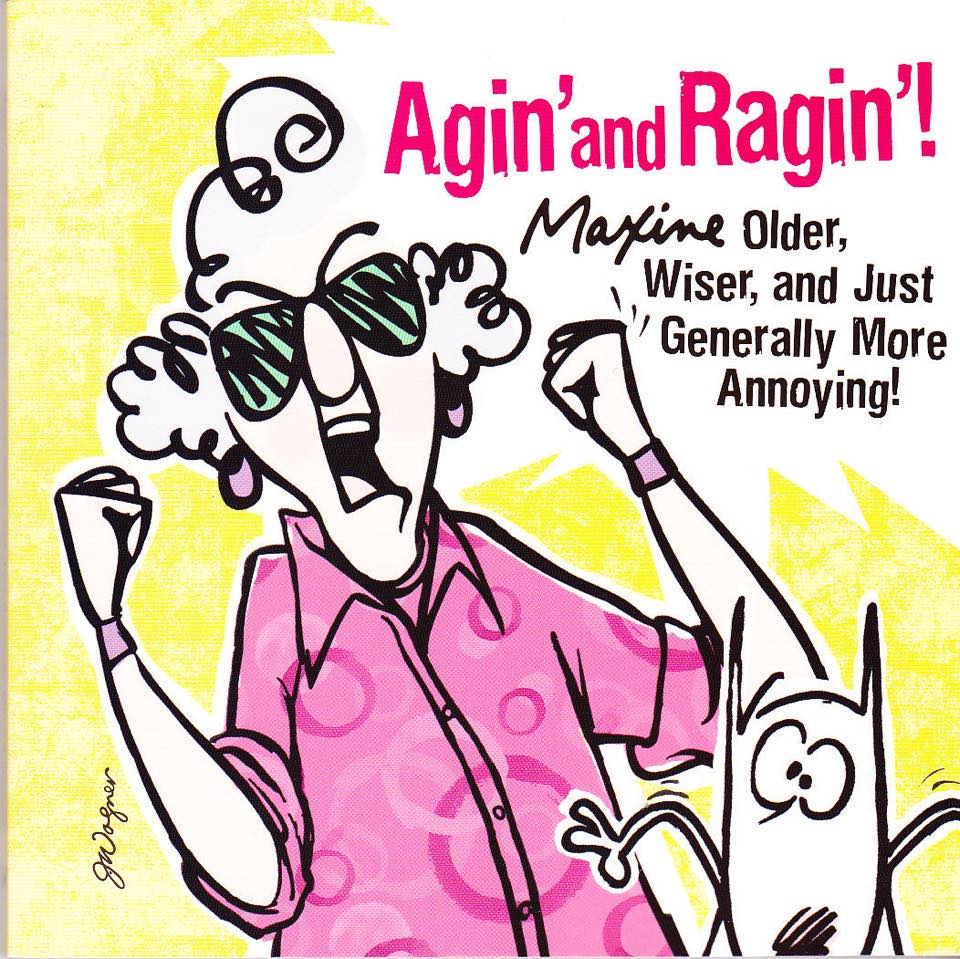
“Old age is an excellent time for outrage,” said senior citizen advocate Maggie Kuhn, adding, “My goal is to say or do at least one outrageous thing every week.”
I don’t know if she was the originator of that line or if she was borrowing from novelist and critic, Louis Kronenberger, but it is a damn fine suggestion no matter who said it. The thing is, the older you get the more forgiving people are about your eccentricities. The braver we become the older we get too.
What would you do or say that you would consider outrageous?
Maggie Kuhn found her “outrage” when she was forced to retire at the “youngish” age of 65. She wasn’t happy about that and in retaliation formed The Gray Panthers movement. A group of agencies dedicated to fighting ageism and social injustice, including fighting against, the, then, mandatory retirement age of 65.
“Men and women approaching retirement age should be recycled for public service work,” said Kuhn, “and their companies should foot the bill. We can no longer afford to scrap-pile people.”
Her goal of saying or doing something outrageous every week is inspiring. We should actually begin doing it at any age, eh? Take 30 year old Australian field hockey player Matt Dawson who, after injuring his ring finger and risking missing the Olympics, decided to have it amputated so he could compete. That takes outrageous behavior to a whole new level, of course, but he is inspirational.
The late sex therapist Dr Ruth was famous for her clinical, non judgemental but spicy sayings repeated in TIME MAGAZINE following her recent death.
‘“Women need sex,” she explained in 2019. She urged women not to fake orgasm unless they had to, a “little white lie” to protect a man’s feelings—although she recommended that women break off relationships with men who couldn’t handle a little critical feedback about their performance in bed.”’
Oh, how glorious was she?
Kuhn’s position on sex for older adults was nothing if not controversial as well. As women live longer than men, she advocated sex with younger men, or even other women.
Writer Stella Fosse read Kuhn’s biography and learned that Kuhn also “conducted an affair with a married minister, about which she writes openly. ‘“Many women who become involved with married men sicken themselves with guilt. I did not. I was troubled occasionally by the thought of his wife, but probably not enough. There are so many rules that govern our lives. But there are certain natural urges and strong attractions that overpower the rules. Sometimes you act on those urges and sometimes you don’t.” One of the great things about Kuhn’s memoir is her candor about her love affairs. “I had a reputation for being a real snake charmer with men,” she wrote. Even in her eighties, she describes a man friend taking her hand and saying, “When are we going to have our affair?”’
Controversial comments or acts can be much less infuriating when committed by a senior citizen, like Kuhn, Dr Ruth, because, I guess, they’ve earned it.
For instance, when an older person cuts me off in traffic because they can’t be bothered to turn around their arthritic neck to see who’s behind them I don’t mind as much as I would if it were someone younger who was just plain rude.
SPEAK UP is all that Kuhn is advocating. So, I tried out Kuhn’s Code of Outrageous Conduct the other evening. While dining in a lovely restaurant with a great friend of mine we were approached by a tall, somewhat cocky, but not altogether unattractive, young waiter -a bit bored with the whole process, I must say-whose first words to us were, “Honey, can I get you something?”
“Um, a better attitude would be nice,” I thought, but- SHOCKINGLY- did not say. He was efficient and thorough, I’ll give him that. But the persistent use of HONEY to address us became tiresome. It wasn’t an affectionate use of the term either, like when the waitress at a little diner says, Hon, what’ll you be having?” Or when a London taxi cab driver flirtatiously addresses women of all ages, as Love. His behavior felt, well, a little mean.
At first I thought it was a cultural or language barrier. He was from Eastern Europe. But his English was pretty spot on so his terminology to us was clearly quite deliberate.
When we paid the bill and were exiting the restaurant I stopped for a minute and walked over to him. “You were a very efficient server, ” I said and thanked him. “But may I suggest that the next time you wait on women, might you refrain from calling them HONEY? He looked at me with a steady eye and waited-knowing there was more. “Because I am not your Honey. And it feels dismissive and ungentlemanly.”
He turned his head a little, nodded just a bit and said abruptly but not rudely,
“You learn something new every day.”
Who knows what he actually “thought” of this confrontation or if it would change his behavior in future. Perhaps I sounded a bit old fashioned to him. But I felt it needed to be said. And why keep such things to yourself if in saying them a benefit might be had? I don’t know if Kuhn would consider that this interaction actually rose to the level of “outrageousness” but it was a start. And it’s only week one.
 Burning Daylight